
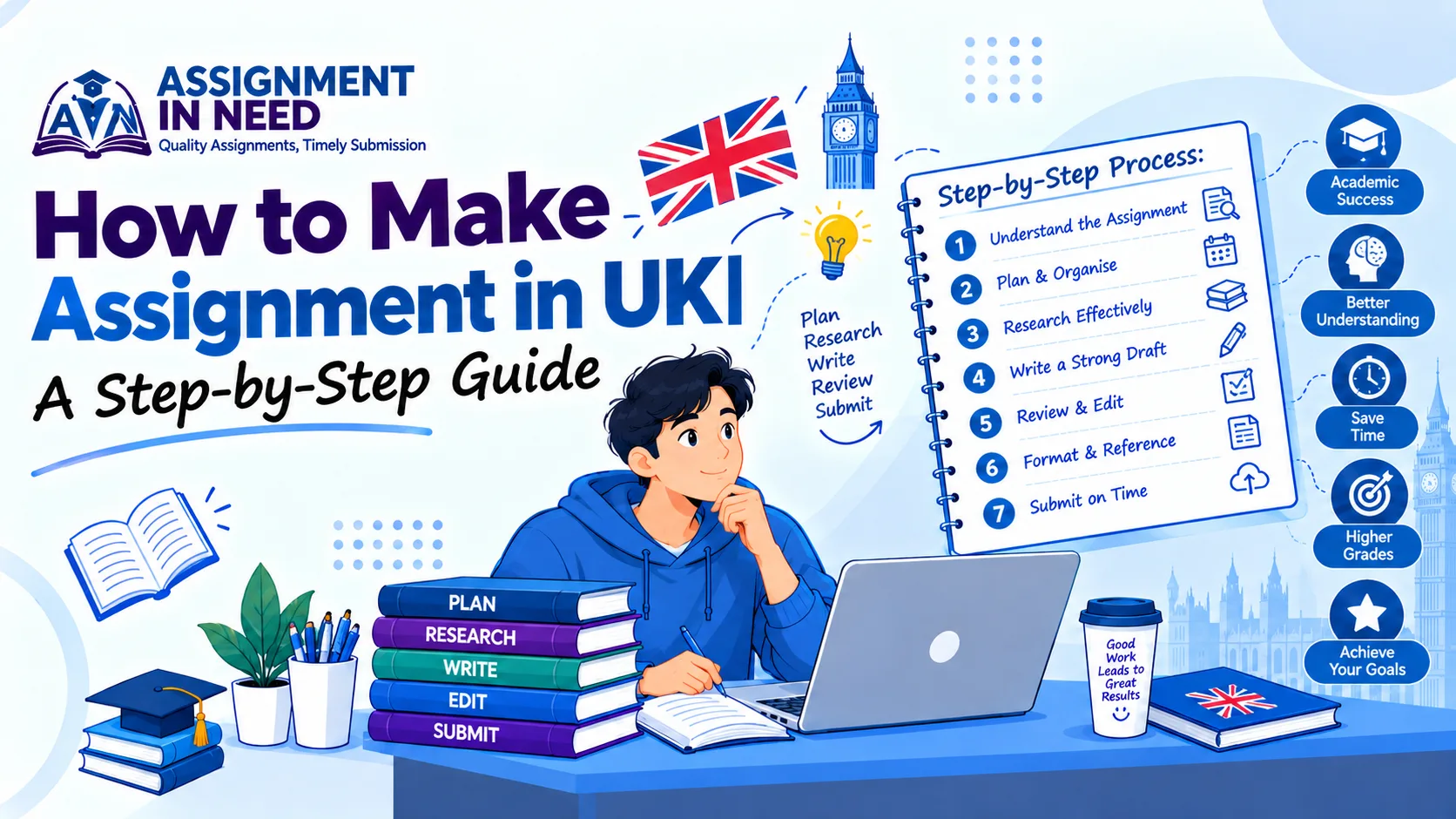
What separates a stressful assignment deadline from a well-organised submission? Often, it comes down to knowing where to start and what to do next. To most university students, it may be difficult to understand how to make assignment in UK. This is mainly because of high academic standards, conducting research independently, referencing styles and the need to observe strict word limits. The fact is that unlike at school level tasks, at university level, you will have to create logical arguments, assess credible evidence and demonstrate a good understanding of your subject. However, it does not mean that you will have to figure out everything on your own. Following the correct approach, even the toughest assignment will become a number of smaller tasks.
This blog will guide you step by step through all the stages starting from understanding the assignment brief, selection of topics, research, writing the structure, referencing and proofreading your assignment.
What to Know Before Starting Your Assignment
Before getting down to writing, one should have an understanding of how to make assignment in UK and what universities actually require. There are a few assignments that are common and each kind has its own individualities.
- Essays
- Reports
- Case studies
- Reflections
- Brief research papers
To learn how to do Assignment in UK institutions, it is necessary to look through the guidelines of your particular institution carefully because marking criteria, formatting standards and other important details may vary across departments. It is important to note that academic integrity is a huge part of the process too. Professors demand originality, proper referencing and paraphrasing, and credible evidence supporting the argument and not only an opinion. Having the criteria of assessment in front of your eyes is the easiest way to meet the expectations of the lecturer.
Step 1 - Decode Your Assignment Brief Before You Begin
Any good piece of work begins with reading the brief carefully and not skimming through it. Underline command words like analyse, evaluate, or discuss since all of them require a different response. Before you go any further, ensure that all of the below aspects are covered in your notes.
- The exact word count
- The submission deadline
- The required referencing style
- Any specific sub-questions the brief raises
This is also the time to understand what the marker wants and not guess what he or she might be looking for. In case there is something unclear in the brief, it will be much more helpful to ask a tutor than to just write your paper in the wrong direction. Thirty minutes spent on interpreting the brief at the beginning will save you a lot of time for rewriting later.

Step 2 - Choose Your Topic and Define Your Main Argument
If a writing task offers flexibility in terms of the chosen topic, try to choose something you are able to write confidently instead of something simply reflecting on the situation. An effective task always includes a clear statement of the idea, which is known as a thesis statement, supported by other parts of the paper.
Choosing a narrowed topic helps to do research more effectively as it allows you to concentrate on certain sources rather than a general topic. Try to write your argument in one sentence before doing any research. If you are not able to put your idea into one sentence, your topic is probably too broad.
Step 3 - Research Smartly Using Reliable Academic Sources
Research should always be based on quality and not quantity. Peer reviewed journal articles, textbooks and reports are more authoritative and credible than any general search over the internet, which is why academic database in university libraries are generally the right place to start. Most students these days take help from online assignment for students resources such as library guides and referencing software in order to speed up this process without compromising on the credibility of sources. Anybody who is searching how to make Assignment in UK online will usually realize that most of what he needs can be found through his university library website, even before searching the internet.
One must keep a simple record of all sources used in reading, mentioning the author, year of publication, page number and a brief summary of the point it proves. This one practice alone saves a lot of hassle later when trying to trace back a quote in the citing stage.
Step 4 - Build a Clear Assignment Structure
The structure will help you organize your notes into an assignment that a marker can follow, even if your headings may not be exactly the same as those used by other students.
Introduction - Set the Direction
In the introduction, you should indicate the reason for doing the assignment, make an argument and give the reader an indication of how the discussion is going to progress. Make sure that the introduction is brief and does not reveal everything about the analysis.
Main Body - Develop Your Arguments with Evidence
Every paragraph of the body section needs to make one point based on evidence and then analyze that evidence. Your body paragraphs need to be organized in terms of your argument, rather than in terms of sources, in order for the writing to make more sense.
Conclusion - Bring Your Key Points Together
Conclusion needs to bring the points together and summarize the entire argument without adding any evidence.
References and Appendices - Present Supporting Material
Reference list has to appear at the end, while supporting evidence in the form of raw data or tables goes into the appendix section.
| SECTION | MAIN PURPOSE |
|---|---|
| Introduction | States the argument and direction |
| Main Body | Develops points with evidence and analysis |
| Conclusion | Draws points together, no new evidence |
| References/Appendices | Lists sources, holds supporting material |
Step 5 - Create an Outline and Divide Your Word Count
Even before drafting one paragraph in full, it is necessary to prepare an outline to split up the number of words between the introduction, each main heading, and the conclusion.
| SECTION | SUGGESTED SHARE | EXAMPLE AT 2,000 WORDS |
|---|---|---|
| Introduction | ~10% | ~200 words |
| Main Body | 70-80% | 1,400-1,600 words |
| Conclusion | 10-15% | 200-300 words |
It is not necessary for this outline to be written in a formal style. An informal outline with just a few headings with the approximate number of words needed in each section should suffice.
Step 6 - Turn Your Research into Strong Academic Writing
When there is an outline created for an academic work, then there will be little need to start from scratch while writing, as everything one needs to do now is to fill in the information for each heading or sub-heading. Academic writing uses a formal language instead of a conversational one, and each paragraph must start with a topic sentence.
In order to learn how to write Assignments in UK in an academic style, it is necessary to develop some habits: using specific terms, avoiding redundancies and giving citations instead of making general statements. One can always read the sentences aloud in order to hear if something sounds incorrect or informal.
Step 7 - Reference Your Sources the Right Way
Referencing is not only about formality, but about letting a marker know from which source your evidence came and safeguarding yourself from any plagiarism. There are several referencing styles that suit almost all UK university courses, and it would be best to know what style your particular course uses.
- Harvard - the most popular style used in UK universities, based on author-date system
- APA - widely used in psychology and education
- Vancouver - mostly used in medicine and similar fields, numbered citation system
- OSCOLA - standard style for law tasks and cases references
In-text citation is a way to show the source of the particular idea or quote that is being discussed in the paper, while the reference list provides detailed information about each source that is being cited. These two must correspond exactly, as failing to include a source mentioned in the text into the reference list is among the most typical mistakes made by students.
Step 8 - Edit, Proofread and Polish Your Assignment
These two processes are not the same, despite the fact that most students consider them one single process. In the case of editing, attention is focused on the big picture and, therefore, involves checking the logical flow of the arguments and how well each part responds to the brief. This happens later during the proofreading stage.
Reading your assignment out loud, or having it read by another person, helps to identify the problem areas which are overlooked while spending many hours working on the document. Having some days left before the deadline, you should leave some time between completing your draft and its editing.
Step 9 - Complete Your Final Checks Before Submission
Just before uploading your file, you need to check again that all the requirements of your assignment have been fulfilled.
- Your word count fits within the given limit
- Your formatting matches with that of your brief, which includes font, line space and headings
- The referencing style is consistent in the whole paper
- Your file name, student number and cover page are in the right format
- You checked your plagiarism checker result
Thinking of this step as an important step in how to make Assignment in UK successful is a good practice you should develop for all your modules. Leaving yourself time for submission will also help you avoid any technical problem with your submission.
Common Assignment Writing Mistakes and How to Avoid Them
There are quite a few common mistakes that students make while working on their university assignments, but all of them can be easily avoided when one realizes them. It includes:
- Not paying attention to command words in the assignment brief
- Making a description instead of an argument
- Starting referencing at the last moment
- Separating an excessively long introduction which is identical to the whole assignment
- Bringing new evidence into the conclusion
These mistakes are usually caused by bad time management rather than lack of skills, so it is enough to make a plan and do some editing to fix all of the problems. Those who have doubts about their work can also seek help with assignment writing beforehand.

What Makes a Good Assignment in a UK University?
An assignment must answer the exact question that was raised in it, state a viewpoint clearly and back up everything by reliable facts and not just vague opinions. It must also be structured correctly, since even good ideas will receive low grades if they have not been formatted as instructed.
The difference between a mediocre assignment and an example of best assignment writing for UK university students is not just a matter of IQ, but of discipline: having a plan, doing good research, writing well and having your work checked properly. This is what learning how to make assignment in UK universities is all about.
Assignment Writing Checklist for UK Students
- The task has been read thoroughly and all instruction words have been understood.
- The central argument is stated in one sentence.
- The research is taken from reliable sources that are cited properly.
- The word count has been distributed appropriately between sections.
- All in-text citations have corresponding entries in the references list.
- The task has been edited for structure and proofread for mistakes.
- The document meets the submission criteria perfectly.
Final Thoughts
To sum up, learning how to make Assignment in UK involves a lot more than having a knack for writing assignments; it rather involves developing an easy routine to follow, like, taking time to understand the brief, formulating an argument, gathering information from credible sources, organizing your writing in a sensible way while referencing, editing and checking before submitting the assignment.
If you need extra support throughout any stage of the writing process, ranging from planning to proofreading, you must seek the reliable assignment writing services in UK education to review your work before submitting. Once you have a solid routine, writing assignments will stop to be panic moments and ill become a process that always yields quality academic work.