

Ask any OCR Chemistry student which practical keeps coming back, and many will mention filtering a crystalline solid. A clear Buchner Funnel Diagram OCR A-Level Chemistry answer can win several easy marks, yet students often forget labels or draw an unsealed system. The technique sits at the heart of OCR Practical Activity Group 6, the synthesis of an organic solid, where you make a crude product, filter it under reduced pressure, purify it by recrystallisation and check its melting point. Master it, and a routine practical becomes a reliable source of marks.
This guide gives you a labelled Büchner funnel diagram, a clear method, safety points and an exam-style question to practise. Read on to build both the knowledge and the confidence you need in the exam.
What Is a Büchner Funnel?
A Büchner funnel is a wide, flat-bottomed porcelain or plastic funnel with a perforated plate that supports a circular filter paper. Placed on a thick-walled side-arm flask, it uses suction to pull liquid through quickly, leaving the solid behind on the paper.
In Büchner funnel vacuum filtration OCR practicals, the solid collected on the paper is the residue, while the liquid in the flask is the filtrate. If you ever need help with assignment questions on practical chemistry, learn this vocabulary first, because a Buchner funnel apparatus diagram A-Level question expects these exact terms. You will usually meet it when -
- collecting crystals after recrystallisation;
- separating a solid product from a reaction mixture;
- washing a solid with a small volume of cold solvent.
The funnel is not interchangeable with a normal filter funnel. Its flat plate supports the paper under suction, and its wide surface spreads the solid thinly, which is why liquid drains so quickly and why washing the crystals is more efficient.
Labelled Diagram of the Apparatus
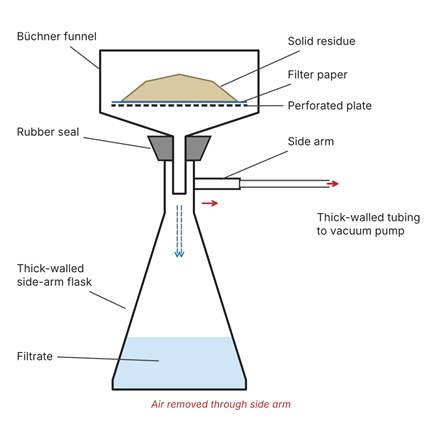
A strong Buchner Funnel Diagram OCR A-Level Chemistry answer shows every part of the set-up and how the parts connect. Use a ruler, draw a sealed system and label each part clearly, because a Büchner funnel labelled diagram OCR mark scheme rewards precise labelling.
Essential apparatus labels
Every Buchner funnel side arm flask diagram should show the funnel, filter paper, rubber seal and flask, plus the side arm that leads to the vacuum. Include the following labels so that examiners can award each mark without guessing -
- Büchner funnel with a perforated plate.
- Filter paper lying flat and covering every hole.
- Rubber seal forming an airtight fit with the flask.
- Side-arm flask, which must be thick-walled.
- Side arm connected to the pump.
- Thick-walled tubing leading to the water pump or vacuum pump.
- Residue on the paper and filtrate in the flask.
A neat vacuum filtration diagram with labels OCR examiners can read quickly uses straight label lines that never cross. Compare your sketch with a labelled vacuum filtration apparatus drawing in your textbook. When you practise how to draw Büchner funnel diagram OCR A-Level style, show the funnel resting firmly in the seal and add an arrow for air leaving through the side arm.
How Vacuum Filtration Works
A pump removes air from the side-arm flask, so the pressure inside falls below the atmospheric pressure above the funnel. This difference pushes liquid through the filter paper quickly. A reduced pressure filtration diagram OCR students draw should therefore show air leaving through the side arm.
- Pressure difference: lower pressure below the paper and atmospheric pressure above it forces the liquid through.
- Faster separation: the filtrate passes through in seconds rather than minutes, so the whole practical runs more smoothly.
- Drier solid: air drawn through the crystals removes much of the remaining solvent, which makes final drying quicker.
Any filtration under a reduced pressure diagram must show a tight seal, because a leak stops the pressure from falling and slows everything down.
Notice that the filtrate drips from the stem into the flask while the solid stays on the paper. Describing this movement clearly in words, as well as showing it in your diagram, helps you secure explanation marks in longer questions.
Step-by-Step Method
Follow the same sequence every time, because OCR practical marks reward careful technique. The method below suits a crude solid from recrystallisation, and it shows how a Buchner Funnel Diagram OCR A-Level Chemistry question links drawing to real practical skill -
- Set up the vacuum filtration apparatus OCR specifications expect: clamp the side-arm flask, fit the rubber seal and rest the Büchner funnel on top.
- Place a circular filter paper flat on the perforated plate so that it covers every hole without climbing the sides.
- Wet the paper with a little cold solvent, so that it sticks and no solid slips underneath.
- Switch on the water pump, checking that the tubing is secure and the seal is airtight.
- Pour in the mixture steadily, guiding it with a glass rod, and rinse remaining solid across with a little cold solvent.
- Wash the crystals with a minimum of ice-cold solvent to remove soluble impurities without dissolving the product.
- Keep the suction on for a few minutes to dry the solid, then disconnect the tubing from the side arm before turning off the pump.
- Transfer the solid to a watch glass and dry it fully. If it still contains impurities, recrystallise it and then measure its melting point.
Always record what you observe, such as the colour and appearance of the crystals, and note the mass of the dry solid for a percentage yield calculation. These details turn a simple technique into complete practical evidence for your Practical Endorsement.
Advantages of Vacuum Filtration Over Gravity Filtration
Vacuum filtration is faster, gives a drier solid and recovers more product than gravity methods, which is why it is preferred for collecting crystals after a synthesis. Use the advantages below to justify your choice of method in written practical questions -
- Speed: liquid passes through in a fraction of the time, which saves valuable lesson time.
- Drier product: air drawn through the solid removes excess solvent.
- Better recovery: fine crystals that clog fluted filter paper are collected easily, so less product is lost.
- Effective washing: small volumes of cold solvent pass evenly through the solid.
- Neat technique: the set-up is simple, and it is easy to draw, explain and repeat accurately.
Common Exam Mistakes and Mark Scheme Tips
Most lost marks in a Buchner Funnel Diagram OCR A-Level Chemistry question come from simple slips, not from a lack of knowledge. Check your answer against the points below, and remember that every part of the diagram needs a precise name -
- Open system: leaving gaps between the funnel and the flask. A filtration under reduced pressure apparatus diagram must show a sealed system.
- Missing connection: forgetting the tube from the side arm to the pump, which leaves the apparatus with no way to remove air.
- Wrong filter paper: drawing it folded up the sides rather than flat on the plate, where it must cover every hole.
- Mixed-up terms: confusing filtrate with residue, which can reverse the meaning of your whole answer.
- Wrong order: turning off the pump before disconnecting the tubing, which can suck water back into the flask.
- Vague labels: writing funnel instead of Büchner funnel. An OCR A-Level vacuum filtration labelled diagram earns marks only for precise names.
Examiners also expect the words airtight and perforated plate, so use them confidently. When you practise an OCR A-Level Büchner funnel diagram, ask a teacher or tutor to mark it. Academic support platforms such as Assignment in Need can also review practical write-ups and explain where marks were lost.
Safety Points
Vacuum filtration is a low-risk technique, but glassware under reduced pressure can fail and solvents can be hazardous. Follow these points in every practical, and mention the relevant ones in your risk assessment so that your planning shows genuine awareness of hazards -
Check the flask for cracks and use only thick-walled glassware, because thin glass can implode under reduced pressure.
- Clamp the flask securely so that it cannot tip when the funnel is loaded.
- Wear safety goggles and keep flammable solvents well away from flames.
- Use tubing designed for vacuum work and fit it firmly to the side arm.
- Disconnect the tubing before switching off the pump, so nothing is sucked back.
Safe practice is part of practical assessment, not an optional extra. Teachers observe how you clamp apparatus, handle solvents and set up vacuum filtration, so careful habits can support your Practical Endorsement as well as your exam answers.
Quick Comparison: Gravity Filtration Vs Vacuum Filtration
Comparing the two methods helps you choose the right one in a practical question and explain your choice. The table below summarises the key differences in a form that is easy to revise, so you can copy the structure into your own notes.
| FEATURE | GRAVITY FILTRATION | VACUUM FILTRATION |
|---|---|---|
| Apparatus | Filter funnel, fluted filter paper and conical flask | Büchner funnel, flat filter paper, side-arm flask and pump |
| Speed | Slow | Fast |
| Dryness of solid | Remains damp | Fairly dry after suction |
| Pressure | Atmospheric pressure only | Reduced pressure below the paper |
| Best used for | Removing unwanted solid from a solution | Collecting crystals or a solid product |
Notice that gravity filtration is not wrong, it simply suits a different job. When you need the clear liquid and want to discard a fine solid, fluted paper works well. When the solid is the product, vacuum filtration is the better choice.

Example Exam-Style Question
Test yourself with this typical question, then compare your answer with the mark scheme points that follow. Try it without notes first, and time yourself, because that is exactly how the exam works and it shows which parts you still need to revise.
Question: A student prepares an organic solid and separates it from the reaction mixture by vacuum filtration. (a) Draw a labelled diagram of Büchner funnel apparatus. [3] (b) Explain why the tubing is disconnected before the pump is switched off. [1] (c) State why the crystals are washed with cold solvent. [1]
- (a) funnel with perforated plate and flat filter paper; airtight rubber seal on a side-arm flask; side arm connected to a pump.
- (b) to prevent liquid being sucked back into the flask.
- (c) to remove soluble impurities while minimising loss of product.
A good answer to part (b) mentions pressure, not just tidiness. Say that disconnecting first lets air into the flask, which stops the pressure difference from drawing liquid backwards.
Conclusion
To sum up, mastering the Buchner funnel is about understanding why each part is there, not just memorising a sketch. A confident Buchner Funnel Diagram OCR A-Level Chemistry answer shows a sealed apparatus, accurate labels and a clear link between reduced pressure and faster filtration. Add the correct method, from setting up the flask to washing and drying the crystals, and you will cover most of what OCR practical questions test, including recrystallisation in PAG 6. Practise drawing the set-up from memory, check each label against the mark scheme and revisit the safety points before your next practical. With steady revision, this simple piece of glassware can become one of the easiest sources of marks in your chemistry papers this year.