
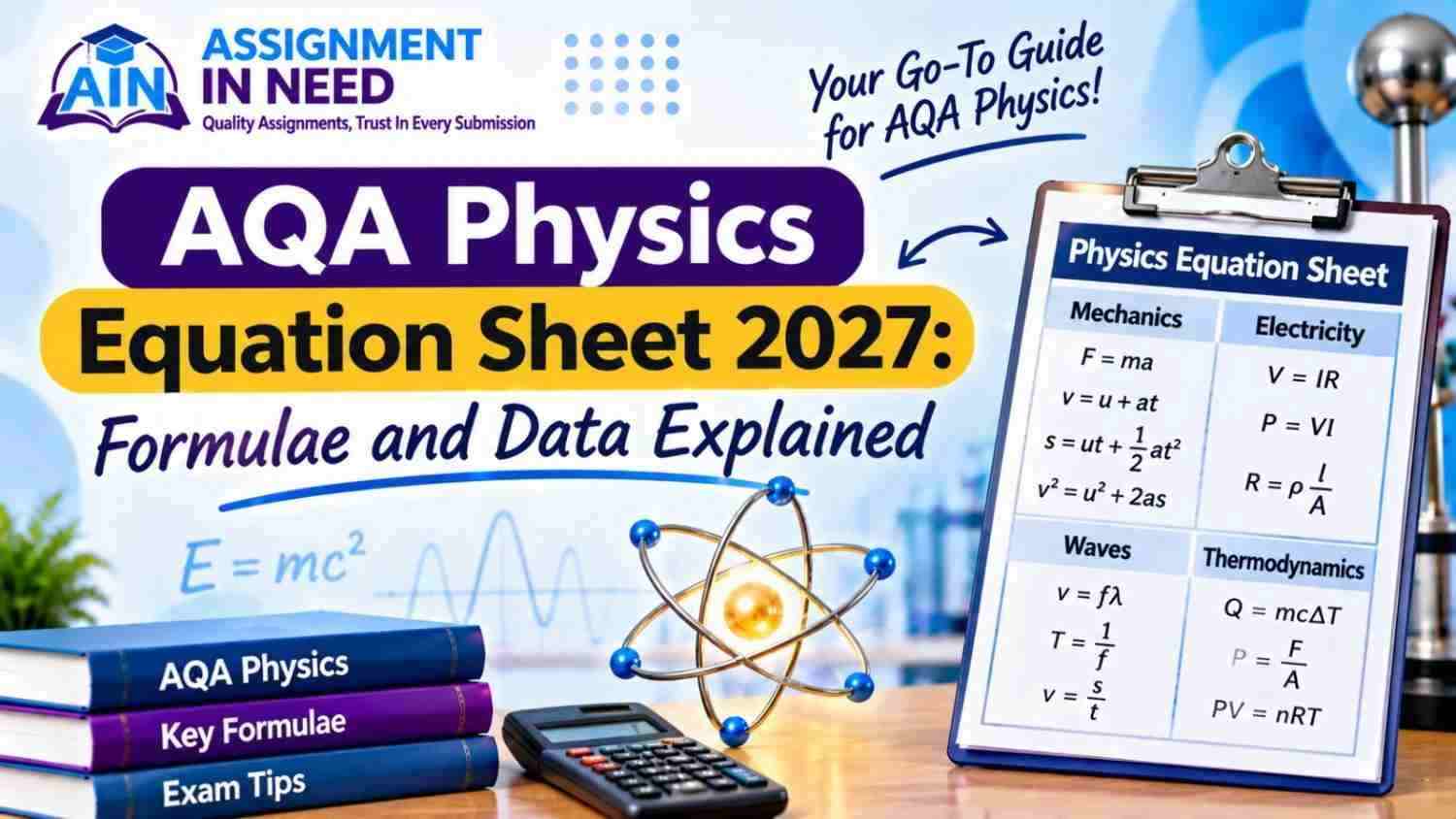
Few moments in an exam feel worse than staring at a calculation question and blanking on the formula. The AQA Physics Equation Sheet exists to remove that panic, yet many students only study it properly in the exam hall itself. Knowing what it contains, what it leaves out and how to use it can protect easy marks across both papers. AQA has confirmed that the 2027 sheet is unchanged from 2026, so you can revise with it from today.
This guide walks through the AQA GCSE Physics equation sheet, explains every symbol and unit, and shows how to apply each formula under pressure. By the end, you will know exactly where to look, what to practise next and how to avoid the slips that cost valuable marks.
What Is the AQA Physics Equation Sheet?
The AQA Physics Equation Sheet is an official insert that AQA places inside GCSE Physics (8463), Combined Science: Trilogy and Combined Science: Synergy papers. It lists formulae for calculation questions in words and symbols, so you can spend your time applying physics rather than recalling it.
What AQA provides in exams
- A clean copy with every paper: you cannot bring your own annotated version.
- Words and symbols together: each equation links a written question to the algebra.
- HT markers: Higher Tier only equations are labelled HT.
- Nothing else: no units or worked examples.
Equations you must memorise
For 2027, AQA states that you will not need to memorise the physics equations. You must still learn every unit, the meaning of each symbol and how to rearrange, because the sheet cannot do those jobs.
Equations given in the exam
Every equation you are expected to use is printed on the insert, from kinetic energy to transformers. The 2027 version matches 2026, so last year’s copy works for revision.
Is an AQA Physics Equation Sheet Different From a Physics Equation Sheet GCSE?
Many students use the two names as if they mean the same thing. In practice, one is a general label and the other is an official document. Searching for a physics equation sheet GCSE returns dozens of lists, and some include equations AQA does not print. The table shows which one deserves your trust.
| POINT TO CHECK | WHAT IT MEANS | WHAT YOU SHOULD DO |
|---|---|---|
| What “GCSE equation sheet” usually means | A broad label for any list of GCSE physics formulae. Layout, symbols and completeness vary. | Use it for revision only. |
| How the AQA version differs | The official insert for specification 8463, with fixed wording and HT markers that match mark schemes. | Learn its exact layout. |
| Which sheet applies to your exam | The AQA insert for 2027 if you sit AQA Physics, Trilogy or Synergy. | Confirm your board on your timetable. |
AQA GCSE Physics Equation Sheet for 2027
This section sets out the equations on the 2027 insert, grouped by topic so you can learn them in context. AQA prints them without headings, so these groupings are for revision only. Always check your copy against the official download.
Energy equations
Energy questions appear in almost every paper, so these formulae reward early practice. The particle model equations sit here too, because density, change of state and gas pressure connect closely to thermal energy and its transfer. Learn the symbols before you memorise the layout.
| QUANTITY | EQUATION |
|---|---|
| Kinetic energy | Ek = ½mv² |
| Gravitational potential energy | Ep = mgh |
| Elastic potential energy | Ee = ½ke² |
| Change in thermal energy | ΔE = mcΔθ |
| Power | P = E/t and P = W/t |
| Efficiency | useful output ÷ total input (energy or power) |
| Density | ρ = m/V |
| Change of state | E = mL |
| Gases | pV = constant |
Electricity equations
Circuit questions often chain two equations together, such as finding current first and then power. These six formulae cover charge, potential difference, power and energy transferred, so keep them together when you see a circuit diagram. Practise linking them in pairs.
| QUANTITY | EQUATION |
|---|---|
| Chargea flow | Q = It |
| Potential difference | V = IR |
| Power | P = VI |
| Power | P = I²R |
| Energy transferred | E = Pt |
| Energy transferred | E = QV |
Forces and motion equations
This is the largest group on the insert, covering weight, work, springs, moments, pressure, motion and momentum. Higher Tier equations are marked HT. Many exam questions simply link two of these formulae. Check the tier label before choosing one, then write the unit.
| QUANTITY | EQUATION |
|---|---|
| Weight | W = mg |
| Work done | W = Fs |
| Spring force | F = ke |
| Moment of a force | M = Fd |
| Pressure | p = F/A |
| Pressure in a liquid (HT) | p = hρg |
| Distance travelled | s = vt |
| Acceleration | a = Δv/t |
| Uniform acceleration | v² − u² = 2as |
| Resultant force | F = ma |
| Momentum (HT) | p = mv |
| Force and momentum (HT) | F = mΔv/Δt |
Waves equations
The waves group is short, which makes it a good place to gain quick marks. Wave speed links frequency and wavelength, the period is the reciprocal of frequency, and magnification helps with lenses and microscopes. Short topics like this suit quick daily retrieval practice.
| QUANTITY | EQUATION |
|---|---|
| Period | T = 1/f |
| Wave speed | v = fλ |
| Magnification | image height ÷ object height |
Magnetism and electromagnetism equations
These three equations are all Higher Tier only, so Foundation candidates can skip them. They describe the force on a current-carrying wire and the behaviour of a transformer, which links to questions about the National Grid. Check your tier before spending revision time here.
| QUANTITY | EQUATION |
|---|---|
| Force on a conductor (HT) | F = BIl |
| Transformer voltages (HT) | Vp/Vs = np/ns |
| Transformer power (HT) | VpIp = VsIs |
Space physics equations
The insert has no separate space physics group, because this topic is mostly descriptive. Calculations set in space usually borrow equations from other groups, so recognising the link matters more than learning anything new:
- Weight on other planets: use W = mg with the gravitational field strength given in the question.
- Distance travelled by a signal or spacecraft: use s = vt.
- Electromagnetic waves from stars: use v = fλ.
Physics Equations Sheet AQA: Every Formula Explained
A formula is only useful when you understand every letter in it. The Physics Equations Sheet AQA provides is compact, so each symbol carries a lot of meaning. This section decodes symbols, units and rearranging. Each part is quick to master with regular practice.
What each symbol means
Symbols repeat across topics, which causes confusion. A capital E means energy, while a lowercase e means extension, and p can mean pressure or momentum. Check the equation each time. The table lists common symbols. Say each quantity aloud as you read it.
| SYMBOL | QUANTITY | UNIT |
|---|---|---|
| E | energy | J |
| P | power | W |
| m | mass | kg |
| v, u | final, initial velocity | m/s |
| a | acceleration | m/s² |
| F | force | N |
| s | distance | m |
| t | time | s |
| g | gravitational field strength | N/kg |
| I | current | A |
| V | potential difference | V |
| R | resistance | Ω |
Correct units for physics equations
Units earn marks, and the insert does not print them, so you must know them. A correct number with a missing unit often loses the final mark. These habits help:
- Write the unit every time: attach it to the answer, not just the working.
- Use base units: kg, m and s give joules, newtons and watts directly.
How to rearrange equations quickly
Rearranging is the skill the sheet cannot teach, yet it unlocks almost every calculation. Whatever you do to one side, do to the other. Isolate the unknown before you substitute numbers, which keeps your working tidy and errors visible.
- V = IR becomes R = V/I: divide both sides by I.
- Ek = ½mv² becomes v = √(2Ek/m): multiply by 2, divide by m, then take the square root.
AQA Physics Equations Sheet: Higher Tier vs Foundation Tier
Both tiers receive the same insert, but they do not use every equation. The AQA Physics equations sheet marks Higher Tier content with HT, so you can see at a glance what applies to you.
| TIER | EQUATIONS YOU NEED |
|---|---|
| Equations required for Foundation Tier | Every unmarked equation, covering energy, electricity, density, forces, motion, waves and magnification. |
| Additional equations for Higher Tier | All of the above, plus six HT equations: p = hρg, p = mv, F = mΔv/Δt, F = BIl, Vp/Vs = np/ns and VpIp = VsIs. |
Common equation mistakes in exams
- Choosing by letter, not meaning: two equations may both contain P, so match the quantity first.
- Forgetting to convert: grams, minutes and kilojoules must change before substitution.
AQA Physics Data Sheet: Constants, Units and Conversion Factors
Many students search for an AQA Physics data sheet and expect a booklet of constants like the one used at A Level. At GCSE, the picture is simpler. The equation insert is the only reference sheet, and numerical values usually arrive inside the question.
Constants provided by AQA
The insert has no constants table. When a calculation needs a value, the question normally states it, so read the wording carefully before you search the sheet. Typical examples include:
- Gravitational field strength: commonly 9.8 N/kg, sometimes rounded to 10 N/kg.
- Specific heat capacity, latent heat and speed of sound: supplied when a calculation needs them.
SI units and prefixes
SI units are the standard system used in all calculations. Prefixes simply scale them, so a kilometre is one thousand metres. Learning these prefixes helps you convert quickly and spot answers that are far too big or small. Prefix errors are easy to avoid.
| PREFIX | SYMBOL | MULTIPLIER |
|---|---|---|
| mega | M | 10⁶ |
| kilo | k | 10³ |
| centi | c | 10⁻² |
| milli | m | 10⁻³ |
| micro | μ | 10⁻⁶ |
Unit conversions You Must Consider
Most lost marks from conversions come from rushing. Before substituting, scan every value and ask whether it is in base units. These conversions appear most often. Write the converted value separately:
- Grams to kilograms: divide by 1,000.
- Centimetres to metres: divide by 100.
- Minutes to seconds: multiply by 60.
- Kilojoules to joules: multiply by 1,000.
- Kilometres per hour to metres per second: divide by 3.6.
How to Use the AQA Physics Equation Sheet in Exams
The best way to use the AQA Physics Equation Sheet is as a check, not a crutch. Decide what physics is involved first, then confirm the formula on the insert. This five-step routine keeps you calm, saves time and protects method marks on every calculation question.
Identify the quantity you need
Start by underlining the quantity the question asks for, such as force, energy or time, and then list the values you are given. This simple step narrows the search to one or two equations before you even glance at the insert.
Choose the correct equation
Look for the equation that contains your unknown and the quantities you already have. Do not pick a formula just because it looks familiar. If two options seem possible, check which one uses only the data given in the question.
Convert units before calculating
Check every value against base units before you substitute. Convert grams, centimetres, minutes and kilojoules first, and write each converted number on its own separate line, then double-check it. This tiny pause prevents powers-of-ten errors that quietly ruin otherwise correct answers.
Show full working for method marks
Write the equation in symbols, rearrange it, substitute the numbers and then state the answer with its unit. Examiners award method marks for each stage, so a wrong final answer can still earn most of the available credit. Neat working also helps you spot errors.
Check units, rounding, and significant figures
Finish by asking whether your answer is sensible in size and unit. Round to the number of significant figures in the data, usually two or three. A car accelerating at 400 m/s² should send you straight back to check your working.

AQA Physics Equation Sheet Practice Questions for 2027
Practice turns the AQA Physics Equation Sheet from a list into a habit. Try each question yourself before reading the working. Every example follows the same routine: choose the equation, rearrange if needed, substitute and answer with the unit. Time yourself for extra realism.
Energy calculation examples
Question: A 2.0 kg trolley moves at 3.0 m/s. Calculate its kinetic energy.
Working: Ek = ½mv² = ½ × 2.0 × 3.0² = 9.0 J. The answer is 9.0 J. Write each stage on a new line for clearer method marks.
Electricity calculation examples
Question: A 6.0 Ω resistor carries a current of 2.0 A for 5.0 minutes. Calculate the energy transferred.
Working: P = I²R = 2.0² × 6.0 = 24 W. Time = 5.0 × 60 = 300 s. E = Pt = 24 × 300 = 7,200 J. Note the minutes-to-seconds conversion.
Forces and motion calculation examples
Question: A 1,200 kg car accelerates from rest to 20 m/s in 8.0 s. Calculate the resultant force.
Working: a = Δv/t = 20 ÷ 8.0 = 2.5 m/s². F = ma = 1,200 × 2.5 = 3,000 N. Two equations are chained here.
Waves calculation examples
Question: A water wave has a frequency of 2.0 Hz and a wavelength of 0.75 m. Calculate its speed and period.
Working: v = fλ = 2.0 × 0.75 = 1.5 m/s. T = 1/f = 1 ÷ 2.0 = 0.50 s. Both answers need units.
How to Memorise AQA Physics Equations Effectively
Even though AQA provides the insert, fast recall makes you quicker and more confident. Treat the AQA Physics Equation Sheet as a map you know by heart, and connect each equation to a unit and a worked example. These four methods fit short daily sessions.
- Group equations by topic: learn energy, electricity, forces and waves separately.
- Use flashcards and retrieval practice: put the quantity on one side and the equation and unit on the other.
- Practise rearranging formulae: write out every version of each equation until changing the subject feels automatic.
- Apply equations to real exam questions: complete past-paper calculations and compare your method with the mark scheme.
Final Verdict
To sum up, the AQA Physics Equation Sheet is a reliable helper, but it only works well for students who understand it. It will not explain the physics, choose the formula or check your units. Download the official insert, learn its groups, practise rearranging and always write units. Treat every past paper as a rehearsal for the real exam, and keep your working neat.
With steady practice, finding and using the right equation will feel automatic, which leaves your attention free for the physics that actually earns marks. Start today with one topic and build from there.
Need Assignment Help UK?
If calculations or coursework still feel tricky, extra support can make a real difference. Assignment in Need offers assignment help UK students can use to check working, understand method and build confidence. Use it alongside your own practice, so that the skills stay yours on exam day.