
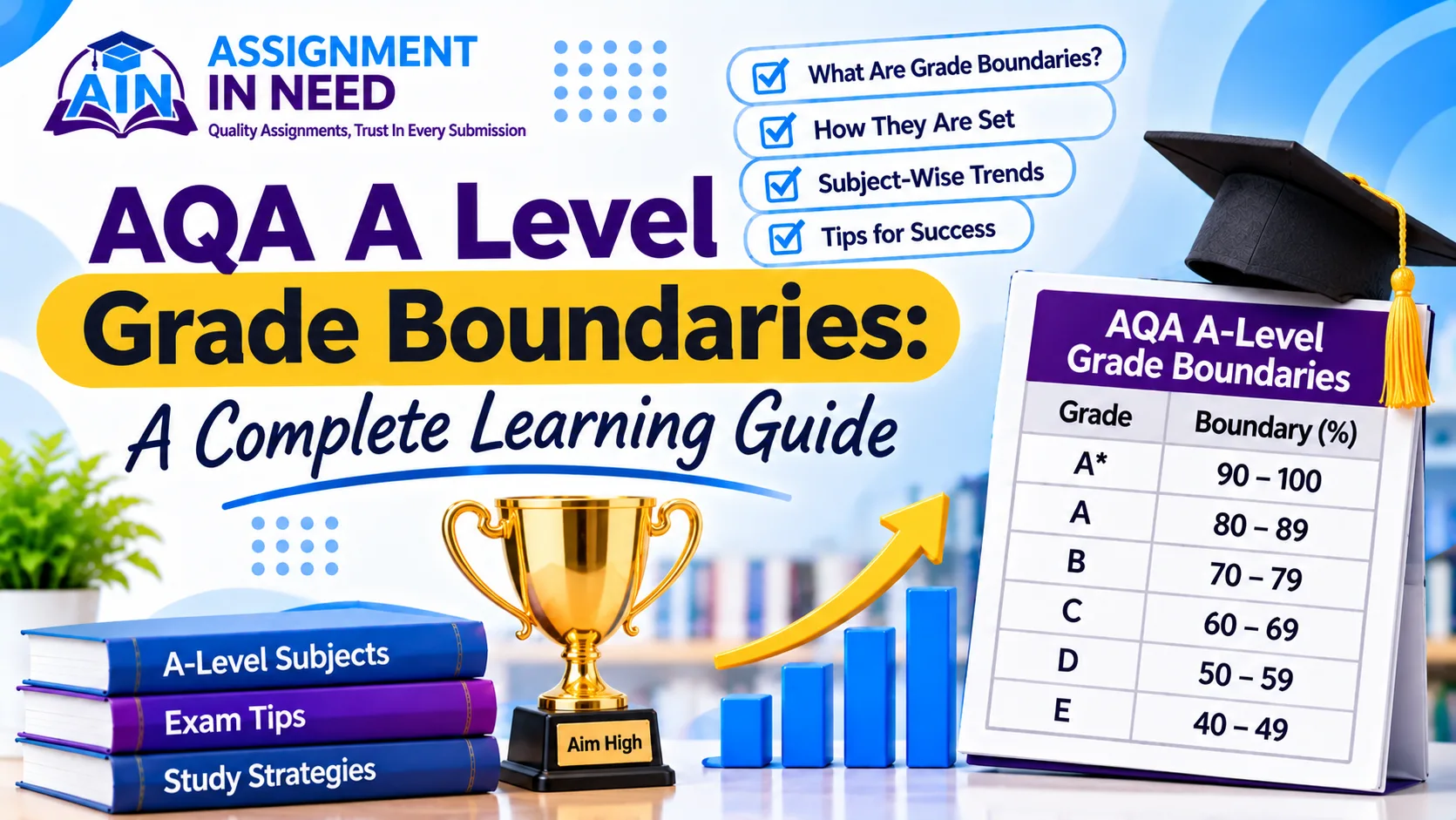
Few things cause as much anxiety in August as a number on a mark sheet that seems to move every year. Understanding AQA A level grade boundaries helps you see that the same percentage can mean different grades in different subjects, and that nothing about the process is random. Boundaries are simply the minimum raw marks needed for each grade, and they are set only after marking is complete, so that standards stay fair from one year to the next.
In this guide, you will learn how AQA grade boundaries work, when they are published, what the 2026 figures were for Maths, Biology, Chemistry and Physics, and how to use them to plan your revision for 2027. Read on, and the numbers will soon make sense.
What Are AQA A Level Grade Boundaries?
Grade boundaries are the minimum marks a student needs to earn a particular grade in an AQA subject. They are not fixed percentages, and they are decided only after every paper has been marked and checked carefully.
Each grade, from A* to E, has its own boundary, and boundaries are published for every subject and, in some cases, for every option within it. If you ever need help with assignments that ask you to analyse exam results, start by learning these three terms -
- Raw mark: the actual marks you earn across your papers.
- Grade boundary: the minimum raw mark needed for a particular grade.
- Grade: the final result awarded, from A* to E.
Imagine a Chemistry student who scores 230 out of 300. Using the 2026 figures, that mark sits above the A boundary of 220 but below the A* boundary of 255, so it would earn an A. In another year, a moved boundary could change that outcome, which is why boundaries matter.
How AQA Grade Boundaries Work
Here is how AQA grade boundaries work in practice. After the exams, examiners mark every script, then senior examiners review sample scripts and statistical evidence before agreeing the boundaries, so that students performing at the same standard receive the same grade as in earlier years.
- Marking: trained examiners mark every paper using the agreed mark scheme.
- Evidence review: senior examiners study scripts close to the likely A and E marks, alongside data on the prior attainment of that year’s students.
- A and E set first: these boundaries combine professional judgement with statistical evidence.
- B, C and D placed between: they are spaced at roughly equal intervals between A and E. In Maths 2026, the boundaries for A, B, C, D and E were 219, 182, 145, 108 and 72, which fall by almost exactly 37 marks each time.
- A* decided separately: it is set above A, using its own evidence about the very strongest performances.
Because boundaries apply to your total across all papers, a weaker performance on one paper can be balanced by a stronger one elsewhere. That is why steady marks on every paper matter more than one brilliant result.
AQA A Level Grade Boundaries Release Date
The AQA A level grade boundaries release date is the same as results day, because boundaries can only be set after marking is complete. AQA publishes them on its website from 8.00am on the morning that students receive their grades.
- Exams officers: see boundaries through AQA’s restricted area from 12.01am on the restricted release day, which is the day before results day.
- Students and parents: can view them on the AQA website from 8.00am on results day.
- 2026 series: A level results day was Thursday 13 August 2026.
- 2027 series: AQA lists Thursday 12 August 2027 for A level results, with GCSE results a week later on 19 August 2027.
No exam board can publish boundaries earlier, so any website claiming to know the 2027 figures today is guessing. On results day, compare your total raw mark with the published boundary for your subject and option. Your grade is already decided, but the boundary shows how close you were, and whether asking your school about a review of marking is worth considering.
Latest AQA A Level Grade Boundaries for 2027 Students (Based on 2026 Data)
There are no official 2027 numbers yet, so the latest AQA A level grade boundaries for 2027 students are those from the June 2026 series. Use them as a guide to typical marks rather than a promise. The table shows minimum raw marks for each grade.
| SUBJECT (CODE) | TOTAL | A* | A | B | C | D | E |
|---|---|---|---|---|---|---|---|
| Mathematics (7357) | 300 | 260 | 219 | 182 | 145 | 108 | 72 |
| Biology (7402) | 260 | 199 | 174 | 146 | 118 | 90 | 63 |
| Chemistry (7405) | 300 | 255 | 220 | 181 | 142 | 104 | 66 |
| Physics (7408, by option) | 250 | 186 - 191 | 157 - 162 | 132 - 136 | 107 - 111 | 82 - 86 | 57 - 61 |
- Read across a row to see the minimum raw marks for each grade in that subject.
- Compare the gaps between grades: Maths falls by about 37 marks per grade, Biology by about 28 and Chemistry by about 38 or 39.
- Convert marks to percentages before you compare one subject with another.
These figures are June 2026 minimum raw marks as reported by third-party boundary trackers, so please confirm them on AQA’s own boundaries page before relying on them. Physics varies by paper option, which is why ranges are shown.
AQA A Level Grade Boundaries 2027 - What Students Should Expect
Nobody can state what the AQA A level grade boundaries 2027 will be until the papers have been sat and marked next summer. What you can do is understand the patterns that make boundaries reasonably predictable.
- Similar ranges: the A boundary in 2026 sat at about 73% of total marks in Maths and Chemistry and about 67% in Biology.
- Small movements are normal: boundaries usually shift by a few marks, depending on how demanding the papers were.
- Standards are protected: the system aims to keep grading consistent with earlier years, so a harder paper tends to bring lower boundaries and an easier paper higher ones.
- Specification changes matter: check whether your subject’s papers or mark totals have changed before comparing years.
Plan around a target mark that sits comfortably above last year’s boundary, rather than aiming for the exact number. A useful habit is to keep a note of your subject’s boundaries across several years once they are available, because patterns over time are far more reliable than any single year.
Subject-Wise AQA A Level Grade Boundaries (Key Examples from 2026)
Each subject has its own total marks, so the same percentage can mean a different grade. Here is how the AQA A level grade boundaries from 2026 compare across four popular subjects, followed by a few others.
AQA A-Level Mathematics
Mathematics (7357) has three papers and 300 marks. In June 2026, an A* needed 260 marks, about 87%, an A needed 219, or 73%, and an E needed 72, or 24%. Notice how evenly the middle grades are spaced. Because they sit about 37 marks apart, picking up extra marks on every paper matters.
AQA A-Level Biology
Biology (7402) is marked out of 260. An A* needed 199 marks, about 77%, an A needed 174, or 67%, and an E needed 63, or 24%. Its A* boundary is a lower percentage than in Maths or Chemistry. With a smaller total, each mark carries slightly more weight, so avoid careless losses on short answers.
AQA A-Level Chemistry
Chemistry (7405) is marked out of 300. An A* needed 255 marks, or 85%, an A needed 220, or 73%, and a B needed 181, about 60%. A solid 60% overall would therefore have secured a B. Calculation and practical marks add up quickly, so check your working in every section.
AQA A-Level Physics
Physics (7408) is marked out of 250, but boundaries differ by option. An A* needed between 186 and 191 marks, roughly 74% to 76%, an A between 157 and 162, and an E between 57 and 61. Check your own option, because the A* boundary alone differs by five marks, and confirm which option your school entered you for.
Other Popular Subjects
Other subjects follow the same logic, with their own totals. These 2026 figures show the A* and A boundaries as reported for four popular choices, and the percentages make comparisons with the sciences much easier -
- Psychology (288 marks): A* at 229, about 80%, and A at 205, about 71%.
- Business (300 marks): A* at 212, about 71%, and A at 192, or 64%.
- Economics (240 marks): A* at 178, about 74%, and A at 154, about 64%.
- Geography (300 marks): A* at 246, or 82%, and A at 219, or 73%.
Why Grade Boundaries Change Every Year
Boundaries change because exams change. Even careful examiners cannot make two papers exactly equal in difficulty, so boundaries adjust to keep the standard of each grade steady. Several factors usually play a part -
- Paper difficulty: a tougher paper normally means lower boundaries, while an easier one raises them.
- Cohort evidence: the prior attainment of that year’s students helps examiners judge what outcomes are reasonable.
- Question styles: changes in how marks are spread across short and extended questions can move the totals needed.
- Options and papers: subjects with several options, such as Physics, can have slightly different boundaries for each one.
None of this means the system is unfair. The aim is for a given grade to represent the same standard whether a paper turns out harder or easier, so a boundary that falls in a tough year is not a lowering of standards.
How to Use Past AQA Grade Boundaries to Prepare for 2027
Past boundaries are a planning tool, not a prediction. Used sensibly, they turn a vague goal such as getting an A into a clear target that you can practise towards week by week -
- Find the boundary for your exact subject and option on AQA’s website.
- Convert it to a percentage of the total marks, so that you can compare it with your practice scores.
- Set a target about five to ten marks above the grade you want, which leaves room for a bad day.
- Mark full past papers strictly with the mark scheme, and record each score in a simple table.
- Review the topics where you lose most marks, and revise those first.
For example, if you want an A in Biology and the 2026 boundary was 174 out of 260, a target of about 180 gives you a safety margin. That is roughly 69% overall, which you can then track across your practice papers.

Tips for Achieving Higher Grades Using Boundary Insights
Boundaries show you where marks are won and lost. These habits help you turn that information into better results, without relying on guesses about what the 2027 numbers will be, because consistent habits matter more than predictions -
- Aim above the line: treat last year’s boundary as a minimum, never a target.
- Track by paper: a weak paper can drag down an otherwise strong total, so monitor each one.
- Practise timing: unfinished papers cost more marks than difficult questions.
- Learn command words: describe, explain and evaluate each earn marks differently.
- Get feedback early: ask teachers to mark extended answers, and consider study support, because academic platforms such as Assignment in Need can also review written work.
- Revise the gaps: spend more time on topics where you score below your target than on those you enjoy.
Common Mistakes Students Make When Interpreting Grade Boundaries
Boundaries are easy to misread, and the mistakes below can lead to poor revision decisions. Watch out for them when you compare your practice marks with published figures, especially around mock exams and results day -
- Treating them as fixed: boundaries change every year, so last year’s number is only a guide.
- Comparing subjects directly: 73% in Maths is not the same as 73% in another subject, because totals and papers differ.
- Ignoring options: Physics and some other subjects publish different boundaries for different options.
- Trusting unofficial predictions: only AQA’s published boundaries are reliable, so be careful with early forecasts.
- Aiming for the exact mark: a target on the boundary leaves no safety margin.
Avoiding these errors keeps your preparation realistic. Use boundaries to set sensible targets and to understand your results, not to worry about numbers that nobody can predict.
Closing Thoughts
All things considered, grade boundaries are far less mysterious than they first appear. They are minimum marks, set after the exams, to keep each grade fair from year to year. The 2026 figures give you a sensible guide, but the real AQA A level grade boundaries for 2027 will only be published on results day in August. Until then, aim comfortably above last year’s numbers, practise with full papers and learn from every mark you drop.
Check AQA’s own site for official figures, ask your teachers about your specific option and keep your revision steady, so you walk into the exam hall calm and prepared. A clear target and honest practice will always matter more than any prediction you read online.